
In the field of affiliate marketing, cookie stuffing is a common form of fraud. This occurs when tracking cookies are installed on users' devices.without their knowledge. This allows fraudsters to receive commissions for actions they didn't actually commit.
The consequences extend beyond just lost costs. Businesses also face issues such as inaccurate marketing data, unreliable performance reports, and misallocated advertising budgets.
In fact, many retailers have recorded thousands of "fake" conversions in a short period of time, originating from a small group of fraudulent affiliates. This shows that cookie stuffing is not just a technical issue but also directly impacts business performance.
In this article, Hidemium Antidetect BrowserWe will explore the nature of cookie stuffing, its causes, and the common methods used by fraudsters.
1. What is cookie stuffing?
Cookie stuffing is a form of affiliate marketing fraud where tracking cookies are attached to a user's browser without any real interaction.
This leads to:
Fraudulent affiliates still receive commissions.
The system incorrectly identifies the conversion source.
Advertisers have to pay for invalid results.
For example, one fashion brand discovered that hundreds of clicks were being recorded through "hidden" cookies, causing them to lose thousands of dollars in a single campaign.
1.1 Why does stuffing cookies happen?
The primary motivation for this behavior usually revolves around profit:
Fraudulent appropriation of commissions.from orders that I didn't create.
Falsifying data to "polish" performance
Exploiting tracking vulnerabilities with affiliate system
In many cases, a small group of affiliates can fake superior performance on major platforms, even though the actual revenue comes from other channels.
The underlying causes include:
The monitoring system is not rigorous enough.
Complex multi-channel tracking
It's difficult to distinguish between real and fake traffic.
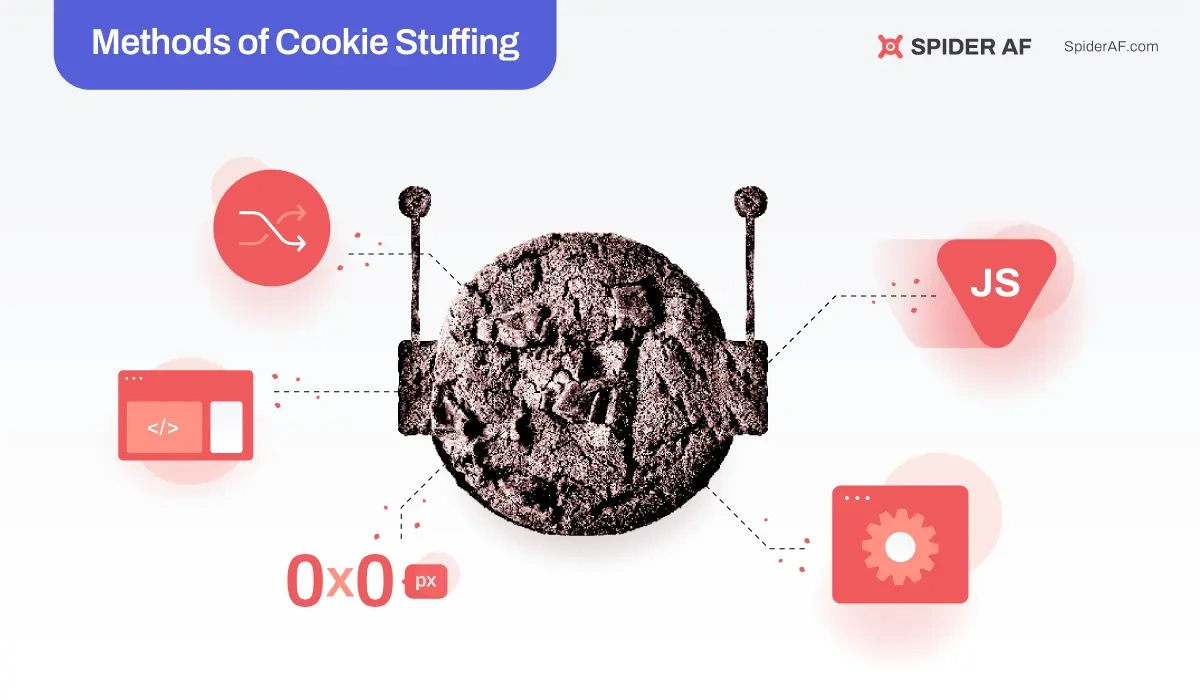
1.2 Popular cookie stuffing techniques
To bypass the system, criminals often use a variety of sophisticated methods:
Hidden iframe: Embed an invisible frame into the website to automatically set cookies
Unauthorized pixel tracking: records clicks/conversions without the user's knowledge.
Malicious browser extensions: large-scale cookie manipulation
These techniques make detecting fraud more difficult, especially when the traffic still looks "legitimate".
For example, one tech company once discovered a browser extension that generated thousands of fake conversions in just one week — forcing them to upgrade their entire tracking and security system.

>>> Learn more:What is Chrome's DNS net internals? How to clear the DNS cache in Chrome?
2. The impact of cookie stuffing in affiliate marketing
Cookie stuffing is not just a "fraudulent trick," but it also causes a range of serious consequences for businesses — from finances and data to brand reputation.
Direct financial damage
One of the obvious consequences, especially marketing budget losses.
When cookies are stuffed:
The system records fake clicks and conversions.
Businesses still have to pay commissions to fraudulent affiliates.
Advertising costs are inflated without creating real value.
For example, a medium-sized e-commerce shop once lost over $50,000 in a single quarter due to "hidden" cookies recording fake orders.
This shows that fraud not only affects the data, but also directly eating into business profits.— especially for campaigns with limited budgets.
Falsifying data and marketing analytics.
Besides financial losses, cookie stuffing also causesThe entire measurement system is inaccurate..
Specifically:
The converted data is incorrect.
Incorrect traffic attribution
misjudging the effectiveness of marketing channels.
When data is "noisy," businesses are more likely to make wrong decisions, for example:
Increase budget for underperforming channels.
Ignoring traffic sources that actually generate revenue.
One tech startup once encountered a situation where some channels "looked very effective" simply because of hidden cookies — leading to wasted money over the long term.
Brand and operational risks
Beyond just money and data, cookie stuffing also affects:
brand reputation
Affiliate partner relationship
internal operating procedures
When fraud is detected:
Businesses lose trust in networks or publishers.
Additional resources will be needed for inspection, processing, and remediation.
The reporting and reconciliation process was disrupted.
A major retailer once had to delay all commission reconciliation after discovering that many affiliates were using cookie stuffing to "steal" revenue.
In the long term, these problems can lead to:
Affiliate marketing systems lose credibility.
It is difficult to attract quality partners.
This reduces the effectiveness of the entire marketing strategy.
>>> Learn more: What is WebGL? How to effectively check and activate WebGL fingerprint authentication.
3. How to detect cookie stuffing
Early detection of cookie stuffing is crucial for effectively protecting affiliate campaigns. Without timely intervention, fraudulent activities can silently cause significant damage that businesses may not even realize.
Here are three common ways to help you identify abnormal signs:
3.1. Manual verification and data analysis
One of the basic methods isCompare and analyze data manually..
You can:
Track traffic by source
detecting unusual spikes
Check for click behavior from the same IP address or device.
For example, an online shop once discovered hundreds of clicks in a few minutes—all coming from the same IP address. Upon further investigation, they found an affiliate was using cookie stuffing techniques to "steal" commissions.
Although time-consuming, this method helps you gain a detailed understanding and detect potential signs of fraud.
3.2. Using automated detection tools
To optimize efficiency, many businesses choose specialized tools such as:
TrafficGuard
ClickGuard
BluePear
TUNE
These platforms have the following capabilities:
Track click and conversion behavior in real time.
Detecting unusual patterns in traffic.
Automatically alert or block fraudulent sources.
For example, an e-commerce business, after integrating an automated monitoring system, was able to quickly detect and block affiliates showing signs of cookie stuffing, significantly reducing losses.
3.3. Identifying “red flags”
Even without sophisticated tools, you can still detect fraud through unusual signs:
The conversion rate increased suddenly and unreasonably.
Unusual sales spike from a single source
Multiple affiliates are credited for the same order (duplicate attribution).
Repeat traffic from the same IP or device
These signals often indicate that the system is being manipulated.
>>> Learn more: 7 Free Online IP Fingerprint Verification Tools
4. Effective ways to prevent cookie stuffing
To protect revenue and ensure the affiliate system operates transparently, it is necessary to...Proactive measures to prevent cookie stuffing.This is mandatory. Businesses need to combine management processes, technology, and legal factors to minimize risks.
4.1. Implement a strict affiliate management process.
One of the most important steps isRegularly monitoring affiliate activities..
You should:
Track traffic sources and click behavior.
Review for abnormal indicators
Establish clear regulations regarding fraudulent behavior.
For example, an online shop discovered a publisher generating hundreds of invalid clicks. After tightening their verification process and implementing transparency principles, they quickly eliminated the source of the fraud and optimized their budget.
👉 Regular checks and maintaining communication with affiliates help detect problems early and build a more sustainable ecosystem.
4.2. Implementing technical solutions
Technology plays a crucial role in preventing fraud.
Businesses can:
Use fraud detection software.
Track click behavior in real time.
Block suspicious IPs or devices.
Configure browser and cookie security settings.
In addition, tools such asHidemiumIt also helps:
browser environment control
Limit tracking data leaks
Reduce the risk of being manipulated by malicious scripts or extensions.
For example, an eCommerce platform, after implementing a monitoring system, was able to promptly detect and block many unusual traffic sources, resulting in more accurate measurement data.
4.3. Policy Establishment and Legal Compliance
Besides technical aspects, legal factors are also very important.
Businesses should:
Clearly define prohibited behaviors in affiliate contracts.
Include anti-fraud clauses in the policy.
Comply with advertising and data regulations.
A global retail brand has updated its entire affiliate program with stricter fraud prevention measures. The result is:
significantly reduced commission disputes.
Increase compliance levels from partners.
improve system reliability

5. Case study & real-world examples of cookie stuffing
Real-world scenarios are always a valuable resource, helping businesses understand the dangers of cookie stuffing and how to improve their fraud prevention systems.
5.1 Case study: Honey and the lessons of affiliate fraud.
One prime example involves a popular cashback platform.Honey.
During the implementation of the affiliate program, they discovered:
Many affiliates receive commissions without generating actual conversions.
Unusual "cookie injection" behaviors have appeared.
Click and conversion data show signs of being manipulated.
Thanks to careful pattern analysis, Honey quickly:
Identify the source of the fraud.
Block infringing partners.
prevent losses from spreading.
This case demonstrates:Even large platforms can become targets if they lack sufficiently robust monitoring systems..
5.2 Lessons from affiliate networks
From numerous real-world examples, networks have derived several important principles:
Regularly check affiliate activity.
Establish clear and transparent regulations.
continuously monitor data
Many businesses have upgraded their systems by:
Optimizing affiliate management processes
Enhance anomaly detection
Improve the allocation mechanism.
These changes not only help prevent fraud, but also:
Strengthening trust with partners
enhance brand reputation
Ensuring long-term effectiveness for the affiliate program.
5.3 Anti-fraud tools in practice.
Technology is an indispensable element in preventing cookie stuffing.
Some common solutions include:
TrafficGuard
ClickGuard
These tools have the following capabilities:
Real-time detection of unusual clicks
Block suspicious traffic sources before recording commissions.
Identify instances of duplicate allocation.
For example, a system using TrafficGuard successfully blocked a large number of fraudulent clicks before they impacted the budget. Meanwhile, ClickGuard helps detect falsely attributed conversions in just seconds.
6. Enhanced prevention strategy with Hidemium
Tools like TrafficGuard or ClickGuard can help detect unusual clicks. However, in complex systems—especially when managing multiple accounts—businesses still struggle with this.Data isolation, cookie control, and team operations..
That's why antidetect solutions likeHidemiumIt are increasingly being used as an enhanced layer of protection, helping to mitigate the risk of cookie stuffing right from the start.
6.1 Isolating profiles – preventing cookie contamination.
Hidemium allows each account to operate within a separate environment.separate browser profile, with:
Independent IP
individual fingerprint
Cookies and storage are completely separate.
This helps:
Prevent the "spread" of cookies between accounts.
Reduce the risk of tracking manipulation.
Protect the entire system if a profile fails.
👉 Even if one environment is suspected of fraud, the remaining profiles remain safe.
6.2 Manage multiple accounts & work in teams securely.
For affiliate or ad teams, Hidemium provides support:
Assign permissions based on roles (admin, member, etc.)
Share your profile without revealing sensitive data.
Manage multiple accounts centrally on a single dashboard.
Therefore:
Avoid leaking cookies, sessions, or login information.
Reduce errors when multiple people are working together.
Ensuring consistency throughout the entire campaign.
6.3 Process automation (Automation)
Hidemium integrates automation features to optimize operations:
automatic ad checking
Monitoring traffic and unusual behavior.
manage multiple profiles at the same time
These tasks can be performed on a large scale while still:
Maintain data segregation.
Do not reveal tracking information.
Minimize the risks associated with cookie stuffing.
Instead of just "detecting and dealing," Hidemium helps you.Prevent fraud from the start.by:
completely isolate the operating environment
Strict control over data and cookies.
Optimizing multi-account management and teamwork.
👉 When combined with fraud detection tools, this will be a strong layer of protection to keep your affiliate campaign running smoothly.safe, transparent, and sustainable.

7. FAQ – Quick answers about cookie stuffing
Q1: What is cookie stuffing in affiliate marketing?
A:This is a form of fraud where cookies are attached to users' devices without their knowledge, leading to misrepresentation of conversion sources and the theft of commissions.
Q2: How can I detect cookie stuffing?
A:You can identify it through:
Manually check for signs of unusual traffic.
Analyzing suspicious click behavior
Alternatively, use tools like TrafficGuard or ClickGuard to automatically detect fraudulent patterns.
Q3: What is the biggest risk of stuffing cookies?
A: Include:
advertising budget losses
Marketing analytics data discrepancies
This negatively impacts brand reputation and affiliate relationships.
Q4: What are some common cookie stuffing techniques?
A:Some common techniques:
Insert hidden iframe to attach cookies
using fraudulent pixel tracking
Exploiting browser extensions to secretly install cookies.
8. Conclusion
Cookie stuffing remains one of the biggest threats in affiliate marketing, potentially leading to: significant financial losses, inaccurate data, operational risks, and reputational damage.
However, businesses can completely control fraud if they understand the mechanisms behind it, apply appropriate detection methods, and combine technology with effective management processes.
Using tools like TrafficGuard, ClickGuard, and especially Hidemium will help you: monitor unusual behavior in real time, isolate the operating environment to prevent cross-contamination of cookies, and automate processes while ensuring data security.
👉 Don't wait until you're cheated before taking action.Take proactive steps to implement preventative strategies today to protect your campaigns, optimize your budget, and build a transparent and sustainable affiliate system.

Related Blogs

Trường hợp proxy bạn mới mua và check live trên hệ thống nhưng khi chạy trên trình duyệt lại không tải được Trường hợp này do phiên bản core đã cũ, cách sửa ở đây chúng ta thực hiện vào Setting Profiles và chọn Reset Resource để tiến hành tải core chrome mới nhất về nhé. Quá trình tải […]
Are you tired of managing multiple social media accounts daily? What you want is a comprehensive solution for managing social media accounts. Although it requires a lot of effort, having multiple accounts on online platforms is essential and beneficial for businesses. The article will tell you the secret to managing social media accounts effectively, so […]


Affiliate marketing hiện đang là một trong những phương pháp phổ biến nhất để kiếm tiền trực tuyến. Đây là một mô hình kinh doanh mà người tiếp thị quảng cáo sản phẩm hoặc dịch vụ của một công ty khác và nhận được hoa hồng khi có người mua hàng thông qua liên kết […]

.png)
In an era where artificial intelligence is increasingly developing, anti-bot systems and automatic detection mechanisms are also increasingly sophisticated, making finding a antidetect browser Being truly effective is more difficult than ever. However, Hidemium and MuLogin still stand out as two options worth considering with strong anonymity capabilities, helping to maintain stable operations[…]
