
Best Antidetect Browser for Ecommerce 2026
Managing one online store is usually simple. Managing several stores, brands, client accounts, or regional teams is not.
Each ecommerce account may use different cookies, sessions, proxies, extensions, and access permissions. Opening everything in one browser can lead to mixed sessions, wrong-account actions, or insecure password sharing.
This is where an antidetect browser for ecommerce can be useful.
Used responsibly, an antidetect browser creates separate profiles for different stores or projects. Each profile keeps its own cookies, login session, proxy, extensions, language, time zone, and browser settings. Its purpose is to organize authorized access—not to bypass marketplace rules.
There is no universal best option. Hidemium offers a balanced combination of profile management, proxy support, teamwork, and automation. Multilogin is better suited to larger organizations, GoLogin is accessible for beginners, AdsPower is strong for bulk workflows, and Dolphin Anty may appeal to advertising-focused teams.
What Is an Antidetect Browser for Ecommerce?
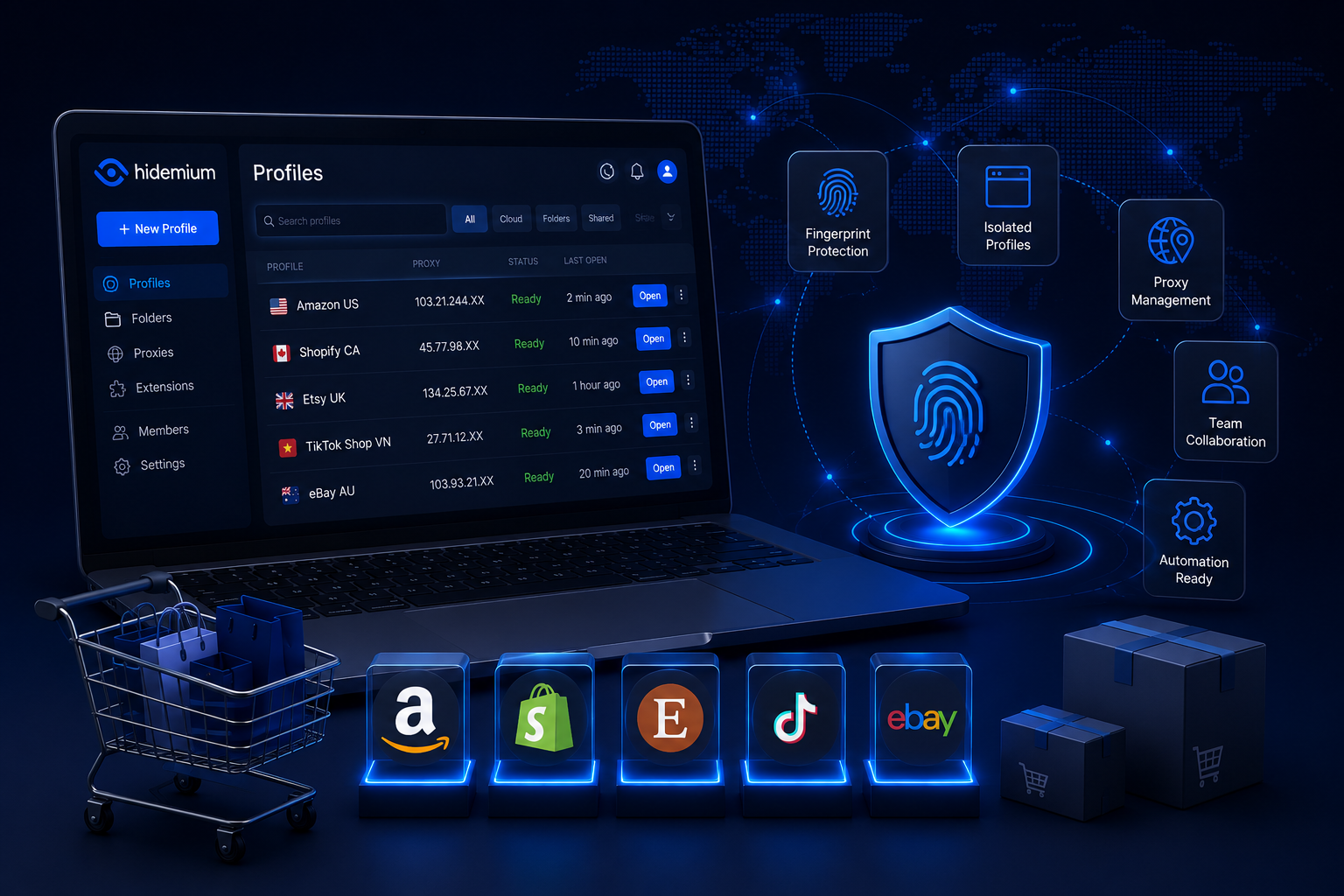
An antidetect browser is a browser management tool that lets users create multiple isolated profiles on one device or inside a centralized workspace.
Each profile behaves like a separate browser environment and can store its own cookies, history, login sessions, local storage, extensions, proxy settings, language, time zone, and browser parameters.
For example, a seller may use separate profiles for Etsy, Amazon, and a client’s Shopify operations. Their stored data should remain isolated.
For ecommerce teams, the main benefit is operational separation. A stable profile helps employees return to the same working environment without rebuilding the session every time.
Why Ecommerce Teams Use Antidetect Browsers
Separate Stores and Client Accounts
Standard Chrome profiles can work for small setups, but they become difficult to manage when a business has many stores, markets, or clients.
A dedicated antidetect browser usually lets teams name, tag, group, search, and assign profiles by marketplace, brand, country, client, or employee.
This reduces the risk of editing listings, answering customers, or running campaigns from the wrong account.
Reduce Password Sharing
Sharing credentials through chats or spreadsheets is insecure and difficult to control.
Profile sharing can give an employee access to an existing browser environment without sending the password directly. Businesses should still use two-factor authentication, unique passwords, and a secure password manager.
Maintain Consistent Login Environments
Repeated changes in device, IP address, language, time zone, or operating system may lead to additional verification requests.
A stable browser profile helps preserve a more consistent environment. In practice, consistency is usually more useful than constantly changing fingerprint settings.
Improve Team Collaboration
Agencies and virtual assistants can use profile groups, employee assignments, restricted settings, profile transfers, and shared notes to manage several clients.
This structure also makes account handovers easier when a team member changes roles or leaves a project.
Support Localized Testing
Businesses operating in several markets may need to review local prices, currencies, checkout pages, redirects, product availability, and language settings.
A regional proxy can support these checks, but testing must still follow website terms, privacy rules, and local laws.
How to Choose the Best Antidetect Browser for Ecommerce
1. Profile Isolation and Stability
Cookies, cache, local storage, and login sessions should remain separate. A platform with many features is not useful if profiles frequently lose sessions or mix data.
Long-term stability is more important than having dozens of settings that the team rarely uses.
2. Fingerprint Consistency
The operating system, browser version, screen resolution, language, time zone, and proxy location should make technical sense together.
Beginners should prefer reliable default configurations instead of manually changing every parameter. An inconsistent combination of settings can create more problems than a standard browser profile.
3. Proxy Management
A good ecommerce antidetect browser should let users assign proxies, test connections, import proxy details in bulk, update credentials, and check IP locations before opening profiles.
Proxy quality matters. Slow or unstable proxies can interrupt sessions and cause loading errors. Businesses should use reputable providers with transparent sourcing and clear usage terms.
A proxy also does not make a prohibited activity acceptable. It should support legitimate operations, testing, or regional access requirements.
4. Team Permissions
For team-based operations, look for administrator and employee roles, profile-level permissions, access revocation, profile transfer, activity records, and restrictions on critical settings.
For example, a customer service employee may need to access a store profile but may not need permission to change its proxy or delete it.
The cheapest plan may not be the best option if it lacks proper access controls.
5. Automation and Integrations
Automation becomes useful when teams repeatedly launch profiles, test proxies, open dashboards, or perform routine internal tasks.
Some tools support APIs, Selenium, Puppeteer, or Playwright. Introduce automation gradually and keep sensitive actions under human review.
Payments, account-information changes, and large-scale customer messages should not be automated without monitoring and approval procedures.
6. Backup, Updates, and Cost
Check how profile synchronization, backup, recovery, and browser-core updates work. Profiles may contain important sessions, extensions, and operating settings, so businesses should understand where the data is stored and who can access it.
Compare total operating cost rather than only the entry price.
Important expenses include active profiles, team seats, proxies, training, technical support, and management time. A higher-priced platform may still deliver better value if it reduces employee errors and manual work.
Best Antidetect Browsers for Ecommerce in 2026
1. Hidemium: Best Balanced Option
Hidemium provides isolated browser profiles, proxy configuration, team management, and automation capabilities in one platform.
Its main advantage is balance across seller, agency, virtual assistant, testing, and growth-oriented workflows.
It may suit sellers managing authorized stores, agencies with several clients, and teams combining manual work with automation.
Users can organize profiles into groups, assign proxies to specific environments, share access with team members, and introduce automated processes as the number of profiles grows.
Potential limitations include the learning curve around proxies and fingerprint settings. Costs may also rise as the number of profiles and team members increases.
Hidemium is a strong overall option for teams seeking profile organization, proxy assignment, shared access, and automation. However, a small seller with only one or two stores may not need a specialized tool.
2. Multilogin: Best for Mature Operations
Multilogin is an established option focused on profile isolation, collaboration, and technical automation.
It may fit large agencies, enterprise teams, companies requiring structured permissions, and technical users working with APIs.
Multilogin can be attractive to organizations that already have documented workflows, technical staff, and clear access-management requirements.
The main concern is cost. Smaller sellers may not need its full feature set, and implementation may require more training and internal documentation.
3. GoLogin: Best for Beginners
GoLogin combines profiles, proxy support, fingerprint settings, and bulk management in an accessible interface.
It may suit freelancers, virtual assistants, small sellers, and teams that need a relatively quick setup.
Its interface can make the initial learning process easier for people who have not used an antidetect browser before.
GoLogin is easier to approach than some advanced platforms, but larger operations may eventually require stronger permissions or collaboration controls.
4. AdsPower: Best for Bulk Management
AdsPower supports large multi-profile workflows across ecommerce, advertising, and social media.
It is useful for teams managing many profiles, users needing bulk imports, businesses using RPA workflows, and operations requiring large-scale tagging or proxy assignment.
Its automation and bulk-management features may reduce repetitive work when a team operates a large number of environments.
However, its feature-rich interface can feel complicated to beginners. Automation should also be configured carefully because one incorrect workflow can affect many profiles.
5. Dolphin Anty: Best for Advertising-Focused Teams
Dolphin Anty is associated with advertising and affiliate workflows but can also support ecommerce campaign teams.
It may fit media buyers, ecommerce marketing teams, and agencies that value a visual interface and API-based automation.
The platform may be particularly relevant when a team manages store accounts together with advertising campaigns and marketing assets.
Its positioning is more marketing-oriented than operations such as order management or customer support, so businesses should test it against their actual workflow.
Quick Comparison
| Tool | Main Strength | Best For | Ease of Use |
|---|---|---|---|
| Hidemium | Balanced profiles, proxies, team access, and automation | Growing ecommerce teams and agencies | Moderate |
| Multilogin | Mature infrastructure and technical integrations | Enterprises and large agencies | Moderate |
| GoLogin | Accessible setup and simple workflow | Beginners and small teams | Easy |
| AdsPower | Bulk profile management and automation | High-volume operations | Moderate |
| Dolphin Anty | Advertising and marketing workflows | Media buyers and marketing teams | Easy to moderate |
This table is only a starting point. Businesses should test a platform with real workflows before moving every account and employee into it.
A short trial can reveal whether profiles remain stable, whether proxies connect reliably, and whether employees can use the interface without creating unnecessary errors.
Are Antidetect Browsers Legal?
An antidetect browser is a browser management tool. Its legality depends on the activity, jurisdiction, and platform rules.
The software does not give a seller permission to create accounts that a marketplace does not allow.
Amazon generally limits sellers to one Seller Central account per region unless there is a legitimate business reason that meets its requirements. Etsy allows multiple shops, but each shop needs a separate account and email address, and owners may need to disclose their other shops.
Other platforms may apply different rules based on location, business structure, account type, or product category.
Review current marketplace, advertising, and payment-provider rules, and use the software only for accounts the business is authorized to operate.
How to Use an Antidetect Browser Safely
Review Platform Rules
List all marketplaces, advertising platforms, payment providers, and tools used by the team. Confirm where multiple accounts are allowed and where approval may be required.
Document these rules so employees understand which accounts can be managed and which actions need authorization.
Create a Clear Naming System
Use consistent profile names, such as:
Platform – Brand – Country – Employee
Example:
Etsy – Home Decor – US – Anna
Avoid vague labels such as “Profile 01” or “New Store.” Clear names become increasingly important as the number of profiles grows.
Keep One Stable Profile per Store
Do not create a new browser profile every time an employee logs in. Keep the same cookies, proxy, time zone, and general environment unless there is a legitimate reason to change them.
Frequent and unnecessary changes can make account management less stable.
Limit Employee Permissions
Use the principle of least privilege. Customer support staff may not need permission to edit proxies or delete profiles. Product employees may not need access to financial systems.
Permissions should reflect each person’s actual responsibilities.
Enable Security Controls
Use two-factor authentication, unique passwords, company email addresses, and secure recovery options.
Browser profile sharing should support an existing security process rather than replace basic account-protection practices.
Test Before Scaling
Start with a few profiles and monitor session retention, proxy stability, resource usage, handovers, and support quality.
Expand only after the workflow becomes reliable. Moving every account at once can make technical problems more difficult to identify.
Common Mistakes to Avoid
Changing Fingerprints Too Often
Constantly changing browser parameters may create an inconsistent environment. Stable settings are usually more practical.
Only change important profile settings when there is a clear operational reason.
Using Unreliable Proxies
Poor proxies may cause slow pages, disconnected sessions, or incorrect regional content. These problems often come from the network rather than the browser profile.
Evaluate proxy stability separately from browser performance.
Opening One Profile Simultaneously
Two employees using the same profile at once can create cookie or session conflicts. Assign clear responsibility for each profile.
Teams should also establish rules for handing a profile from one employee to another.
Automating Too Much Too Soon
Start with low-risk, reversible tasks. Avoid automating payments, sensitive account changes, or bulk messaging without human approval.
Automation should save time without removing essential oversight.
Treating the Tool as a Policy Bypass
No antidetect browser can guarantee that an account will remain active. Marketplaces also evaluate business documents, payments, products, customer service, account behavior, and policy compliance.
A technically separated browser environment cannot correct inaccurate information, prohibited products, or policy violations.
Is Hidemium Suitable for Ecommerce?
Hidemium may be worth considering when a business needs more than standard Chrome profiles.
The Hidemium antidetect browser can help teams separate authorized store environments, group profiles, assign proxies, share access, and add automation as operations grow.
This may be useful for an agency managing several clients, a business operating multiple regional storefronts, or a team working with virtual assistants.
However, a seller with one store and one operator may be better served by Chrome profiles, a password manager, and two-factor authentication.
The best platform is not automatically the one with the most features. It is the one that fits the number of legitimate accounts, team size, security requirements, and level of automation.
Conclusion
The best antidetect browser for ecommerce in 2026 depends on business size and workflow.
Hidemium is a balanced option for sellers and agencies that need profile management, proxy support, team access, and automation. Multilogin suits mature organizations, GoLogin is accessible for beginners, AdsPower is strong for bulk operations, and Dolphin Anty is useful for advertising-focused teams.
Whatever tool a business chooses, three principles remain important:
- Manage only authorized accounts;
- Keep login environments stable;
- Combine profile management with strong internal security.
An antidetect browser should be treated as an operational tool, not as a method for avoiding platform rules.
Frequently Asked Questions
What Is the Best Antidetect Browser for Ecommerce in 2026?
There is no universal best option. Hidemium offers a balanced feature set, Multilogin suits larger organizations, GoLogin is beginner-friendly, AdsPower is strong for bulk workflows, and Dolphin Anty fits marketing teams.
Can an Antidetect Browser Prevent Account Suspension?
No. Account status depends on platform rules, business information, payment details, products, customer service, user behavior, and other factors.
Do Small Sellers Need an Antidetect Browser?
Usually not. It becomes more useful when a business manages multiple authorized stores, clients, employees, or regional environments.
Does an Antidetect Browser Replace a Proxy?
No. A browser profile stores the session and browser environment. A proxy routes the network connection through another IP address.
Is Hidemium Suitable for Ecommerce Agencies?
It may be suitable for agencies that need to organize client profiles, assign employee permissions, maintain separate sessions, and scale automation gradually.
What Should Businesses Compare Before Choosing?
Compare profile isolation, stability, proxy management, team permissions, data security, backup options, browser updates, support quality, and total operating cost.
Related Blogs

In the fast-paced world of social commerce, AI UGC Video Generator tools have become game-changers for brands and creators who need scroll-stopping content without the hassle of traditional shoots. These platforms let you turn product images or simple prompts into realistic user-generated-style videos in minutes.I spent weeks testing popular options—uploading products, tweaking scripts, and even[…]
.png)
In the digital age, protecting privacy and accessing geo-restricted content on Android has become essential. Using a free VPN is an effective solution to browse securely, bypass access restrictions, and protect personal data. Here’s the list of the top 10 free VPN apps for Android in 2025, rated based on speed, security, and user experience.1. What is a VPN and why do you need it on Android?A VPN[…]
CAPTCHAs are designed to distinguish humans from bots, but in the fields of automation and software testing, bypassing this layer of protection is sometimes a necessary requirement. Dedicated CAPTCHA solving services meet that need by combining the power of algorithms with global human resources.In this article, Hidemium will analyze and compare the four leading platforms today — 2Captcha,[…]

If you've ever managed more than one account on the same platform or a second Facebook ads account and a backup Amazon seller profile a handful of social media pages for different clients you've probably run into the same wall. One day the accounts are working fine the next they're all restricted at once even though nothing in your login behavior changed.The usual suspect isn't your browser or[…]

In today's competitive and fast-paced digital world, the absence of regular app updates can lead to the demise of even the most promising applications. Regular updates are a barometer to measure the app's success and help them stay relevant in the long run. If companies don't roll out new features or updates frequently, they need to be prepared for mass uninstallations and increased user[…]
.png)
Are you looking to rent a proxy for use on Facebook, Amazon, Instagram, Shopify, or other platforms? Proxies are not just tools for anonymous access but also help you perform tasks such as data scraping, running ads, or managing multiple accounts effectively. However, each platform has different requirements when it comes to proxy usage. BestProxy, a global proxy service with over 80 million[…]
