
You are looking for information about “What is SAN”and how can this technology help businesses optimize data management? In the era of explosive data development, Storage Area Network (SAN) is considered an ideal storage solution for organizations that need to process and protect large amounts of information. Hidemium Antidetect Browser will help you to learn more about what SAN is, and why more and more businesses are choosing SAN as the foundation for data management and storage in the digital age.
1. What is SAN?
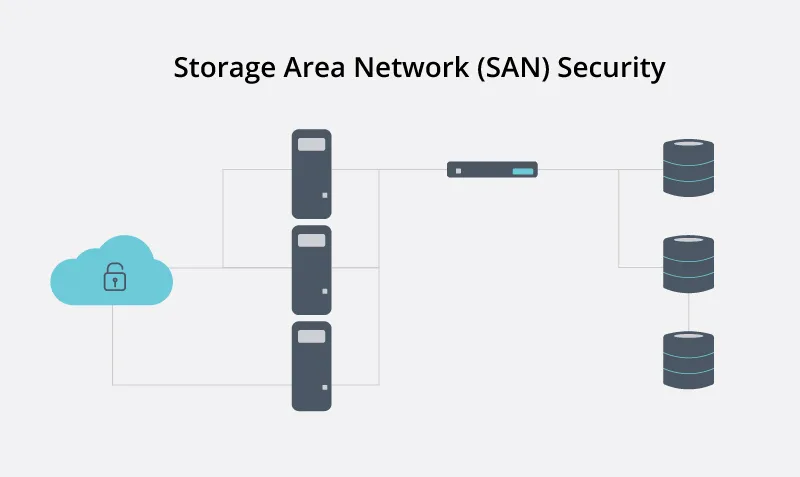
SAN(abbreviation of Storage Area Network) is a dedicated high-speed network system that allows Connect servers to a centralized storage device. Unlike traditional storage solutions, SAN creates a separate network environment, helping Optimize data retrieval and management performance, especially suitable for large businesses or organizations that need to process data continuously and stably.
More than just storage,SAN also delivers superior performance, high reliability and flexible scalability. Businesses in the fields of finance, healthcare, manufacturing, etc. often choose SAN to ensure the safety and efficiency of important data systems.
>>> Learn more: What is a User Agent? How to change UA on 4 popular browsers
2. Main structure of SAN system
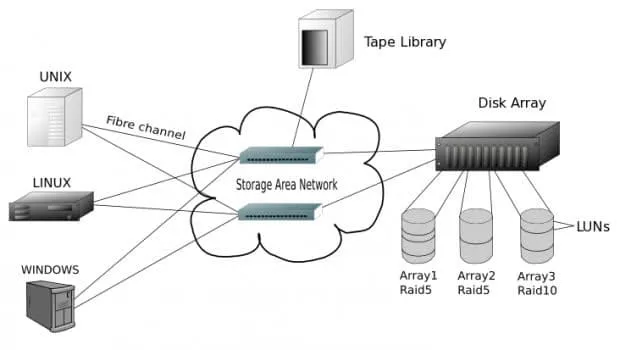
One SAN systemThe standard is built on three main components:
Servers: Is where data retrieval requests are sent and processing operations are performed.
Storage Devices: Including HDD hard drive, SSD drive or RAID system – where data is stored centrally.
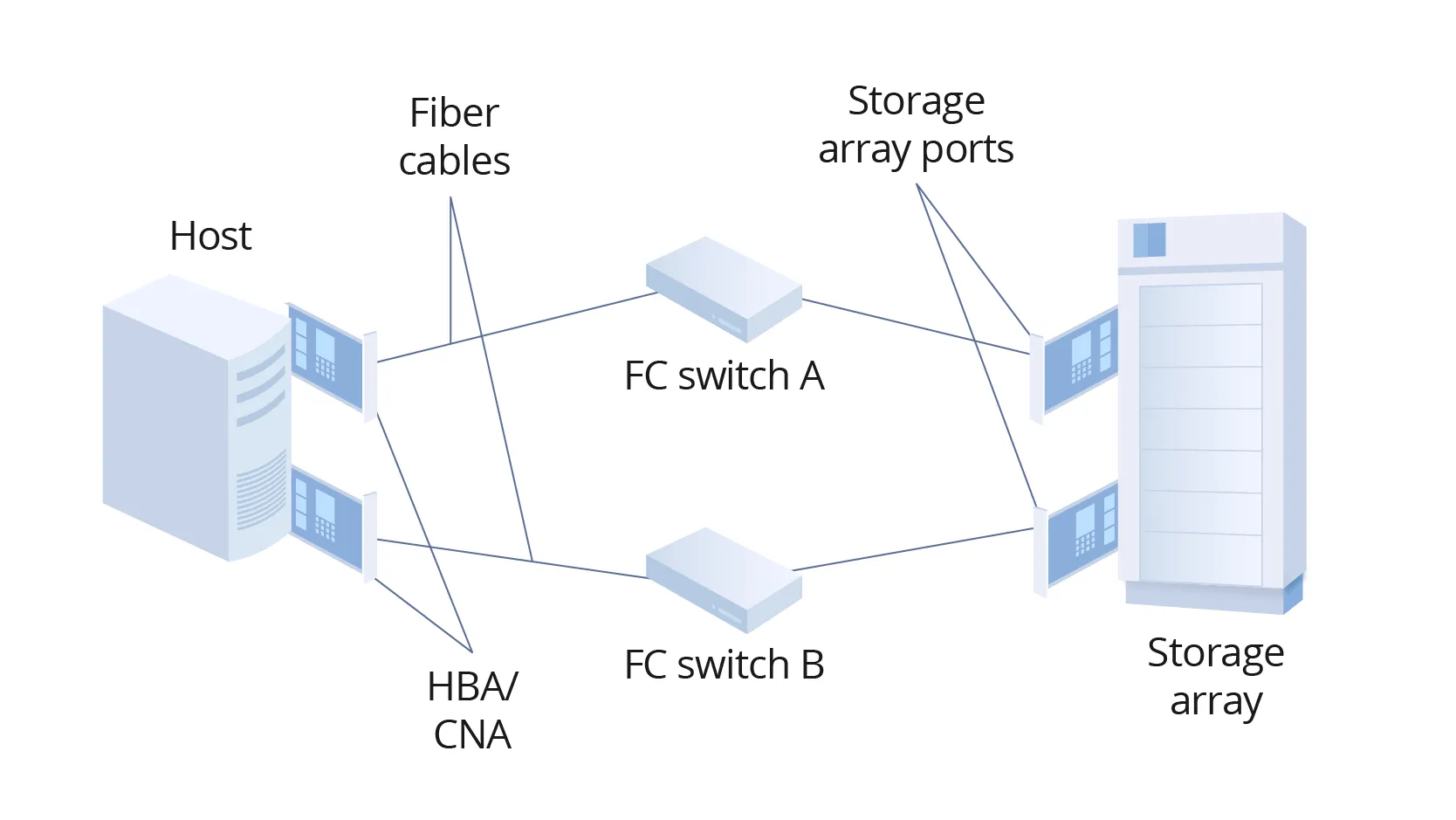
Network Infrastructure: Including devices such as SAN switches, fiber optic cables and connection protocols (Fibre Channel, iSCSI...), acting as intermediaries for data transmission between servers and storage devices.
The tight integration of these components helps the SAN system operate smoothly and reliably. For example, when a server needs to access data, switch SAN will route the request to the correct storage device, ensuring Fast access speed and high stability.
>>> Learn more: What is an ISP? Things to Know About Internet Service Providers
3. Connection protocols in SAN
SAN (Storage Area Network) supports many different connection protocols to optimize data transmission between servers and storage devices. Here are the common protocols:
Fibre Channel (FC): Is a dedicated protocol for SAN, featuringUltra-fast data transfer speed (up to 128 Gbps) and ultra low latency However, the high cost of implementation makes FC mainly suitable for large organizations and enterprises.
iSCSI (Internet Small Computer Systems Interface): Use of infrastructure existing IP network, iSCSI is the choice cost saving than FC, easier to deploy and integrate, although transmission speeds may be lower.
FCoE (Fibre Channel over Ethernet): Combining the advantages of FC and Ethernet, FCoE helps reduce hardware costs but still guarantee stable performance, is a neutral solution between cost and performance.
Practical example: A major bank in Vietnam chooses Fibre Channel To ensure real-time transaction processing capabilities, while small and medium-sized businesses can prioritizeiSCSIto balance efficiency and budget.
>>> Learn more: What is a PAN Network? Advantages, Disadvantages and Applications of PAN
4. Advantages and disadvantages of SAN system
Advantage
SAN systems offer many outstanding values, especially in business environments that require flexible and high-performance storage:
Optimal speed and latency: SAN provides fast data transmission, suitable for applications that require instant processing such as large database systems or financial transactions.
Easy scalability: Businesses can expand storage capacity quickly when needed without interrupting system operations.
High data security: Thanks to its operation on a dedicated storage network, SAN helps reduce the risk of external attacks.
Centralized management: The system allowsCentralized administration through a single interface, helping the IT department easily monitor, operate and optimize the performance of the entire system.
Disadvantages
Despite its many benefits, the SAN system still has some limitations that businesses need to consider:
Large investment costs: SAN deployment requires a large investment in hardware (such as switches, fiber optic cables) and specialized software, which is beyond the capabilities of many small businesses.
High technical requirements: Technical team required in-depth knowledge and experience to deploy, configure and maintain the system.
Complex structure: Compared to storage solutions like NAS, SAN infrastructure is more complicated, requiring careful setup and management.
>>> Learn more: What is a Gateway? Learn more about network gateways
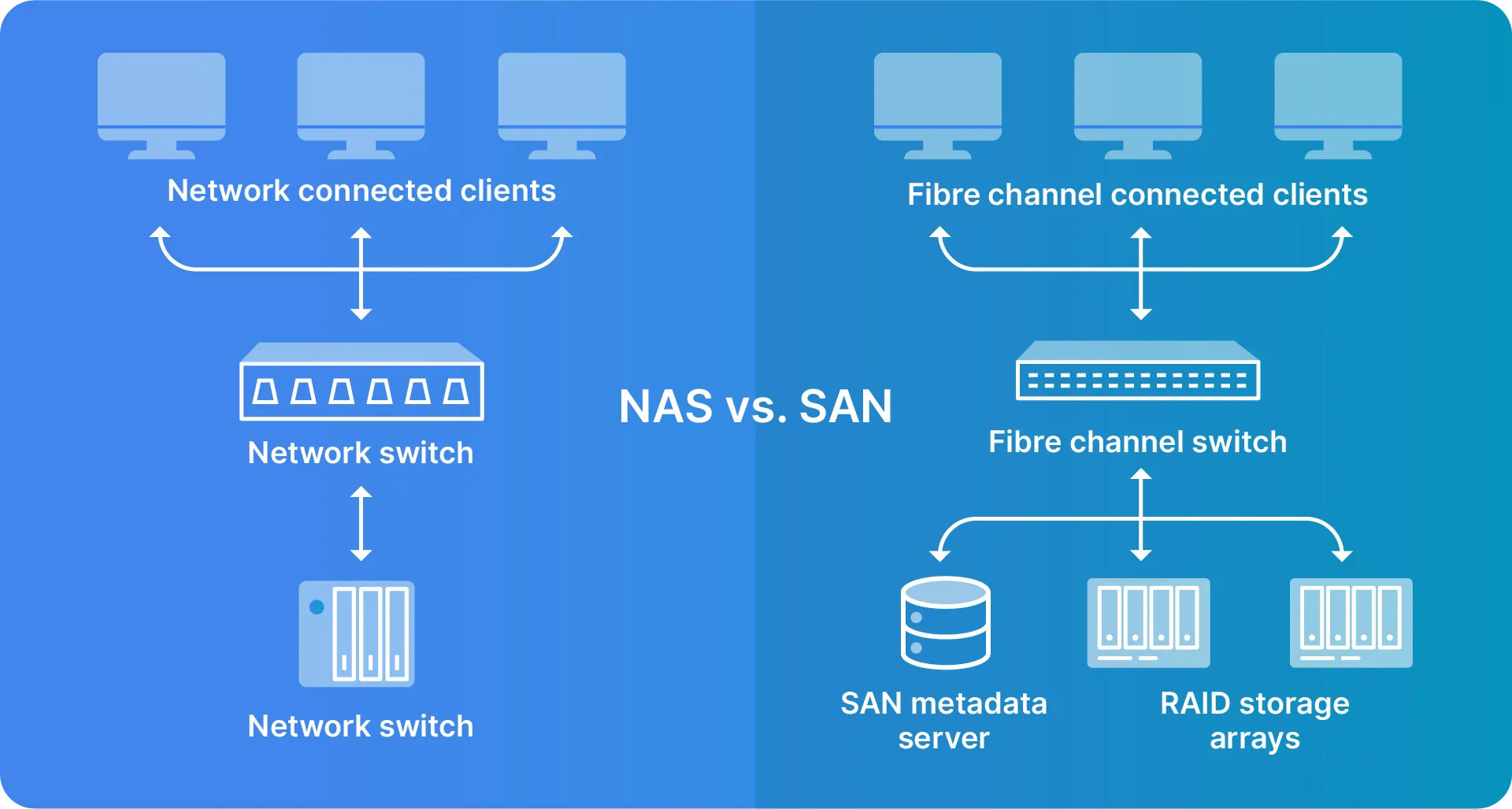
5. Comparison between SAN and NAS: Choosing the right storage solution for your business
SAN (Storage Area Network) and NAS (Network Attached Storage) are two popular data storage solutions today. However, each type has its own advantages and disadvantages and is suitable for different usage needs. The comparison table below will help you easily make the optimal choice:
Criteria | SAN – Storage Area Network | NAS – Network Attached Storage |
| Efficiency | Very high, extremely fast data access speed | Average, depends on internal network quality |
| Investment costs | High, suitable for large enterprises | More economical, suitable for SMB |
| Storage method | Block-level data storage | File-level data storage |
| Scalability | Flexible but requires high technical implementation | Easy to expand, simple to configure |
In short:
SAN is the ideal choice for systems that require High performance and high availability such as data center, virtual server system.
INTO suitable for needs internal data storage and sharing in small and medium office environments.
6. Practical applications of SAN in various fields
Thanks to its high-speed and stable data processing capabilities, SAN is trusted by many businesses and organizations in core operations. like:
ERP/CRM data management: SAN supports fast data storage and retrieval from management systems such as SAP, Salesforce, helping to improve operating efficiency.
Server virtualization (VMware, Hyper-V): Provides a stable hosting platform, helping to ensure performance for complex virtual server systems.
Backup & Recovery: SAN enables fast backups, minimizing downtime and increasing data reliability.
Financial transaction processing: Banks and financial institutions leverage SANs for processing high volume of transactions every day with ultra low latency.
For example, a large hospital in Hanoi deployed SAN for storage.electronic medical record, helping doctors access patient information fast and accurately.
SAN is more than just a storage system, but also Strategic solutions to help businesses manage data effectively, securely and flexibly Although the initial investment cost is higher than NAS, SAN brings outstanding benefits in terms of:
Processing speed
Scaling the system
Ability to integrate with major enterprise platforms
Meet security requirements and 24/7 data availability
Hope the article from Hidemium helped you understand better What is SAN?, as well as why more and more businesses are choosing SAN as the foundation for data management and storage in the digital age.

Related Blogs
WebGL is built similar to a website. Platforms can rely on WebGL exploits to recognize browser fingerprints. So what is the nature of WebGL, advantages, and its applications? And is there a way to block websites from collecting browser fingerprints via WebGL? Overview of WebGL What is WebGL? WebGL stands for Web Graphics Library – […]

Trường hợp proxy bạn mới mua và check live trên hệ thống nhưng khi chạy trên trình duyệt lại không tải được Trường hợp này do phiên bản core đã cũ, cách sửa ở đây chúng ta thực hiện vào Setting Profiles và chọn Reset Resource để tiến hành tải core chrome mới nhất về nhé. Quá trình tải […]

In the connected world, network speed and stability play a key role in every online activity. UDP Proxy (User Datagram Protocol Proxy) appears as an effective support tool to help optimize data transmission performance, reduce latency and improve user experience.In this article, we will learn in detail what a UDP Proxy is, how it works and the outstanding benefits when applied in practice,[…]

What is Cloudflare WARP? This is a service VPN (virtual private network) Developed by Cloudflare, it helps users protect personal data while effectively increasing Internet access speed. If you are looking for a safe, fast and stable web surfing solution, let's go Antidetect Browser Hidemium Explore details about Cloudflare WARP in the article below.1. What is Cloudflare WARP and what's the[…]

Every time you access the internet, a slew of hidden trackers silently collect data about your device — from IP address, system configuration to how the graphics card displays images. Tools Pixels can helps you clearly detect the extent to which your “digital fingerprint” is exposed online.In this article, togetherHidemium discovers What is Pixelscan, how it works, what are its features and when[…]
As businesses become increasingly dependent on the online environment, protecting systems against Distributed Denial of Service (DDoS) attacks is more essential than ever. These attacks not only disrupt services but also cause significant losses to businesses.To protect themselves, businesses need to apply anti-DDoS measures to detect and prevent these attacks. Hidemium stands out as a[…]
