


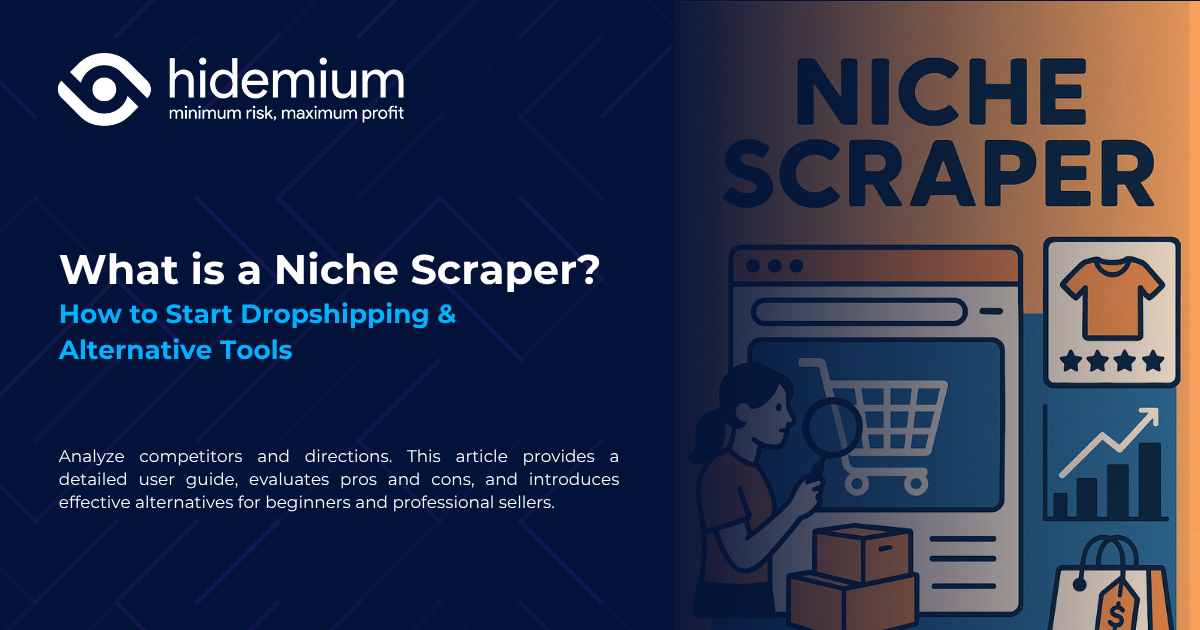
Niche Scraper is a dropshipping product research tool designed to help sellers discover potential products, examine Shopify stores, explore advertising ideas, and evaluate opportunities before investing in inventory-free ecommerce.
But is Niche Scraper the right tool for your business in 2026?
In this guide, we'll explore its features, show you how to research products step by step, explain how to start a dropshipping store, and compare five Niche Scraper alternatives.
Quick Answer: What Is Niche Scraper?
Niche Scraper is a product research platform for dropshipping sellers that combines product discovery, Shopify store analysis, curated product ideas, ad research, and video creation tools.
It can help you identify products worth investigating, but it cannot guarantee that a product will generate sales or profit.
Key Takeaways
- Niche Scraper helps sellers research products before launching advertising campaigns.
- Its core tools include Product Scraper, Store Analysis, Hand Picked Products, Ad Spy, and Video Ad Maker.
- Product research data should be treated as an indicator, not verified future revenue.
- New sellers should validate supplier reliability, shipping costs, margins, and customer demand independently.
- Alternatives such as Minea, Dropispy, Sell The Trend, Ecomhunt, and AliShark serve different research needs.
- Hidemium can support the organization of separate browser profiles for authorized ecommerce workflows, but it does not replace product research or platform compliance.
1. What Is Niche Scraper?
Niche Scraper is an online research platform created for ecommerce entrepreneurs, especially dropshipping sellers.
Instead of searching manually through large product catalogs and social media feeds, users can explore product listings, research stores, and review advertising examples in one place.
The platform is intended to support three important decisions:
- What product should I investigate?
- Is there enough evidence of customer interest to justify testing it?
- How should I position and advertise the product?
For example, a seller interested in pet accessories might use Niche Scraper to discover products, examine competing Shopify stores, and study advertisements in the same category.
However, even strong research indicators cannot replace supplier verification, actual customer feedback, or controlled advertising tests.
Is Niche Scraper Only for Beginners?
No.
Beginners may use it to discover product ideas and understand market trends.
More experienced sellers can use it to compare competitors, explore new categories, and generate hypotheses for product or advertising tests.
The usefulness of the tool depends on how carefully you validate its findings.

2. How to Use Niche Scraper to Find Dropshipping Products
The most effective way to use Niche Scraper is to treat it as the beginning of a research process rather than a shortcut to guaranteed winning products.
Step 1: Choose a Product Category
Start with a product category you understand or want to research.
Examples include:
- Home organization.
- Pet supplies.
- Kitchen accessories.
- Fitness products.
- Outdoor equipment.
- Everyday convenience products.
Avoid selecting a product simply because it appears in a trending list.
Consider customer needs, competition, shipping restrictions, and product quality.
Step 2: Explore Product Scraper
Open Niche Scraper's Product Scraper and examine available filtering options.
Depending on the current interface, filters may include product price, order-related signals, and the time a product was added.
Look for products that meet your initial criteria.
For example:
Product price: Suitable for your intended audience.
Demand indicators: Evidence that the category has attracted buyers.
Competition: Enough market activity to show interest, without assuming lower competition guarantees success.
Shipping: Reasonable dimensions, costs, and delivery expectations.
A product with impressive order statistics may already face heavy competition.
Step 3: Analyze Shopify Competitors
Use Store Analysis to examine relevant Shopify stores and their product catalogs.
Pay attention to:
- Types of products offered.
- Product positioning.
- Pricing structure.
- Store organization.
- Product descriptions.
- Sales-related estimates, where available.
Important: Third-party store analytics may rely on estimates or indirect signals. Do not treat estimated revenue as verified financial reporting.
Look for patterns that can inform your own strategy rather than copying a competitor's entire store.
Step 4: Review Hand Picked Products
Niche Scraper's Hand Picked section provides curated product ideas.
These listings can help you discover products without conducting every search manually.
However, products promoted to a large community may attract competing sellers.
Use the ideas as research leads, not guaranteed opportunities.
Step 5: Research Advertising Examples
Use Ad Spy to examine advertising examples related to a product or category.
Questions worth asking include:
- What customer problem does the advertisement emphasize?
- What product benefits appear first?
- How is the product demonstrated?
- What type of audience might respond?
- Is the advertising message consistent with the product's actual capabilities?
Engagement and advertising visibility can suggest interest, but they do not prove profitability.
Do not copy copyrighted videos, branding, or creative assets without permission.
Step 6: Calculate Your Expected Margin
Before selecting a product, estimate the total cost of fulfilling each order.
Include:
- Supplier cost.
- Shipping.
- Payment processing fees.
- Advertising acquisition cost.
- Expected returns and refunds.
- Platform and app costs.
For example, if you sell a product for $30, pay $10 for the product, $5 for shipping and fees, and $8 to acquire a customer, the illustrative contribution before other costs is $7.
This is only a planning example. Actual profitability depends on your conversion rate, returns, advertising costs, and operations.
Step 7: Run a Small Test
Rather than investing heavily immediately, test the product with a limited budget and clear performance criteria.
Monitor actual orders, conversion rates, customer acquisition costs, and complaints.
If the numbers do not support your assumptions, adjust the offer or move to another product.
3. How to Start a Dropshipping Business in 2026
Product research is only one part of launching a dropshipping business.
A sustainable business also depends on suppliers, customer experience, fulfillment, compliance, and financial management.
Step 1: Select a Niche
Choose a niche with an identifiable audience and problems that a product can reasonably solve.
Use tools such as Niche Scraper and Google Trends to identify research opportunities.
Evaluate:
- Customer needs.
- Competitive positioning.
- Market seasonality.
- Product restrictions.
- Expected profit margins.
Step 2: Find and Verify Suppliers
Potential sourcing options include AliExpress and established supplier directories.
Before selecting a supplier, check:
- Product quality.
- Inventory availability.
- Shipping times.
- Tracking reliability.
- Return and refund policies.
- Communication and support.
Whenever practical, order product samples before investing in advertisements.
Niche Scraper can help you discover products and sourcing leads, but supplier reliability requires separate verification.
Step 3: Build Your Ecommerce Store
Shopify and WooCommerce are two common options for creating an online store.
Choose based on your technical experience, budget, payment requirements, and preferred integrations.
Your store should include:
- Clear product titles.
- Accurate descriptions.
- Original or properly licensed product visuals.
- Transparent shipping information.
- Contact details.
- Return and refund policies.
- Mobile-friendly pages.
Avoid using misleading product claims or copying competitors' store content.
Step 4: Configure Payments and Fulfillment
Set up a suitable payment provider and check whether your business meets its eligibility requirements.
Plan how you will handle:
- Order processing.
- Shipping confirmations.
- Tracking updates.
- Returns.
- Refunds.
- Chargebacks.
- Customer support.
If you need a Shopify-compatible supplier integration, evaluate currently supported services such as DSers.
Do not rely on outdated Oberlo tutorials: Oberlo was discontinued in 2022.
Step 5: Launch Your Marketing Campaigns
Choose advertising channels according to your audience and business objectives.
Potential options include:
Meta Ads: Facebook and Instagram advertising.
TikTok Ads: Short-form video campaigns.
Google Ads: Search and shopping-related customer acquisition.
Start with a test budget and several distinct creative approaches.
Use product demonstrations, accurate claims, and clear landing pages.
A high number of ad impressions does not necessarily translate into profitable sales.
Step 6: Organize Browser Profiles With Hidemium
As ecommerce operations grow, teams may need to manage multiple authorized stores, client accounts, or testing environments.
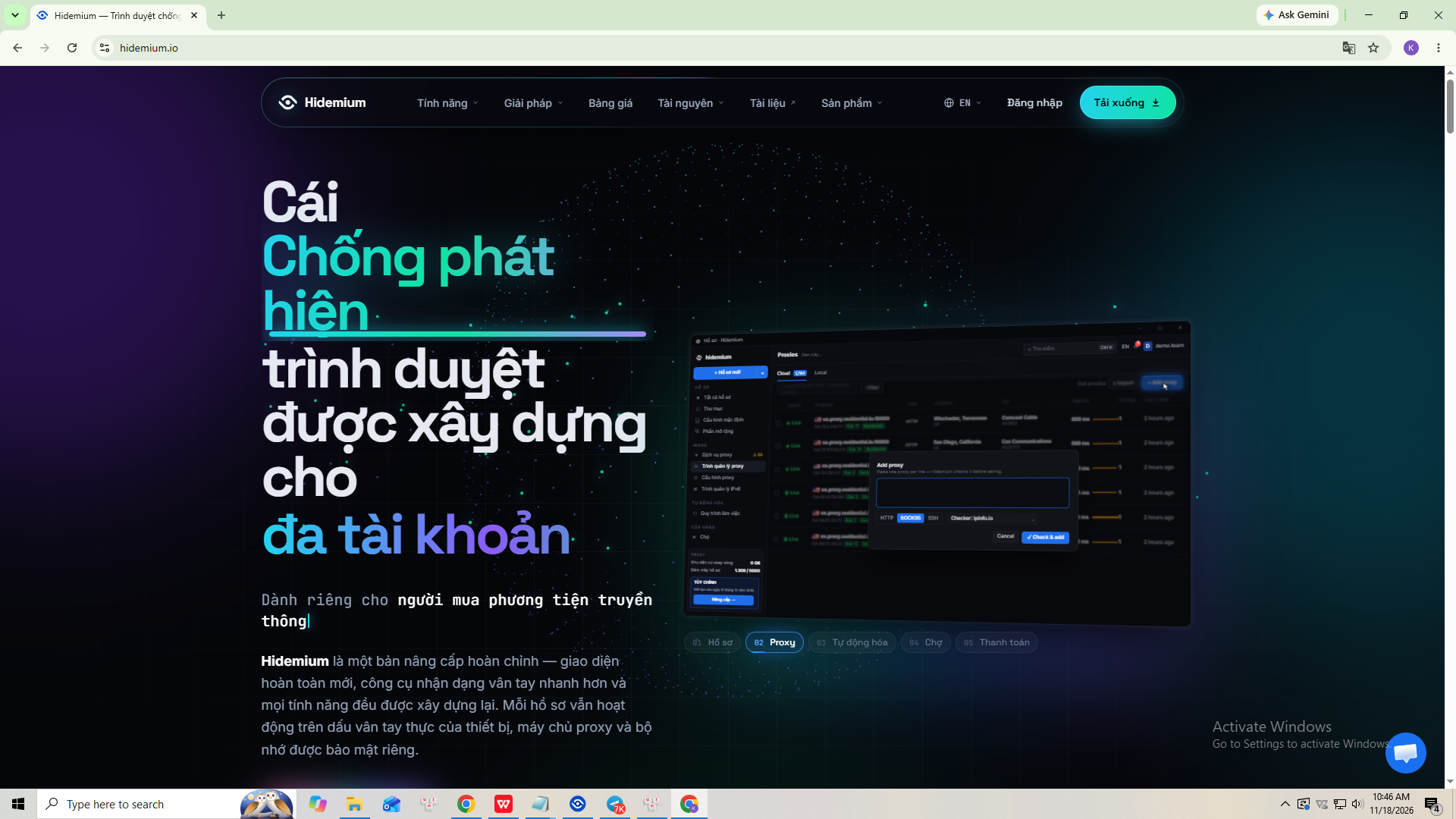
Hidemium is an antidetect browser that supports separate browser profiles with independent configuration and browser storage.
For example:
Store A → Browser Profile A
Store B → Browser Profile B
Client Project C → Browser Profile C
This approach can help organize workflows and reduce accidental mixing of browser sessions.
Hidemium also supports proxy configuration for profiles when a separate network connection is required.
However, a separate browser profile does not automatically provide a different IP address. A proxy must be configured appropriately.
It also does not guarantee immunity from account restrictions.
Always follow the relevant ecommerce platform's rules regarding multiple accounts and account ownership.
Learn more through the Hidemium profile documentation and proxy configuration guide.
Step 7: Monitor Performance and Improve
Use store analytics and advertising platform reports to evaluate your actual results.
Track:
- Conversion rate.
- Customer acquisition cost.
- Average order value.
- Gross margin.
- Refund rate.
- Shipping performance.
- Customer satisfaction.
Scale successful campaigns cautiously and investigate poor performance before increasing spending.
4. Key Niche Scraper Features Explained
Niche Scraper combines several tools that address different stages of product research.
Product Scraper
Product Scraper helps users discover items using available search and filtering options.
It is useful for generating a shortlist of products that match your price, category, and demand criteria.
Best use: Initial product discovery.
Main limitation: Past activity and research signals cannot predict future sales with certainty.
Store Analysis
Store Analysis provides a way to research Shopify stores and examine their visible products and related indicators.
This can help sellers identify competitors and understand how products are presented.
Best use: Competitor and product catalog research.
Main limitation: Estimated sales or revenue should not be treated as verified business data.
Hand Picked Products
Hand Picked Products features curated product suggestions.
This can save time when brainstorming items to test.
Best use: Finding product ideas and advertising angles.
Main limitation: Popular recommendations may be available to many competing sellers.
Ad Spy
Ad Spy helps users research advertising examples and identify creative trends.
It may support analysis of ad formats, product demonstrations, and marketing messages.
Best use: Advertising research and creative inspiration.
Main limitation: Visible engagement does not prove advertising profitability.
Video Ad Maker
Video Ad Maker helps users create promotional video content from product-related assets.
It can be a starting point for simple advertising concepts.
Best use: Initial video concepts and lightweight creative production.
Main limitation: More advanced branding and video editing may require specialist tools.

5. Pros and Cons of Niche Scraper
Before subscribing to any product research platform, evaluate both its strengths and limitations.
Advantages
Beginner-friendly research workflow
The platform combines several activities that sellers otherwise perform across separate tools.
Multiple sources of product inspiration
Product discovery, curated ideas, and advertising examples can support brainstorming.
Competitor research
Store Analysis can help identify relevant stores and compare product positioning.
Advertising inspiration
Ad Spy and video tools can support early creative planning.
Potential time savings
A structured research workflow can be more efficient than searching for ideas without clear criteria.
Disadvantages
Product saturation risk
Products appearing in popular research tools can attract multiple competing sellers.
Research estimates have limitations
Estimated sales and popularity signals are not guaranteed indicators of future profitability.
Supplier quality remains your responsibility
Finding a product does not verify supplier reliability, shipping performance, or customer satisfaction.
Creative tools may be basic
Some sellers will still need advanced editing and branding tools.
Pricing and feature limits may change
Review the current free and paid plans before choosing a subscription.
Is Niche Scraper Worth It?
Niche Scraper may be useful if you regularly research products, examine competitors, or need advertising inspiration.
If you are launching only one or two products, test the available features before committing to a paid plan.
The decision should depend on how much research time the platform saves and whether its insights improve your actual decisions.
6. Five Niche Scraper Alternatives to Consider in 2026
Niche Scraper is not the only tool available for dropshipping research.
These five alternatives serve different needs.
6.1. Minea — For Advertising and Creative Research
Minea is worth evaluating when your priority is researching advertisements, products, and creative trends.
It may be useful for marketers who want to study advertising approaches before developing their own campaigns.
Best for: Ad research and creative inspiration.
Main consideration: Advertising activity is not the same as proven profit.
6.2. Dropispy — For Social Ad Research
Dropispy focuses on researching advertising examples, particularly in the Facebook advertising ecosystem.
It can help sellers explore competitor messaging and product promotion patterns.
Best for: Facebook-oriented ad research.
Main consideration: It may not replace a full product sourcing or store-management workflow.
6.3. Sell The Trend — For Broader Dropshipping Workflows
Sell The Trend combines product research with ecommerce-oriented tools and integrations.
It is worth considering when you want to evaluate research capabilities alongside other store-related workflows.
Best for: Sellers looking for a broader dropshipping toolkit.
Main consideration: Confirm which integrations and features are currently included in each plan.
6.4. Ecomhunt — For Curated Product Ideas
Ecomhunt is a product research platform associated with curated ecommerce opportunities and related research information.
It can be useful for beginners who prefer starting with suggested products.
Best for: Product idea discovery.
Main consideration: Curated products are visible to other sellers, increasing the need for differentiation.
6.5. AliShark — For Product Data Exploration
AliShark is an alternative to investigate when looking for product-related data and filtering capabilities.
Its current service availability and product features should be verified before relying on it.
Best for: Sellers interested in data-oriented product research, subject to current service availability.
Main consideration: Historical product statistics do not ensure current demand.
Which Niche Scraper Alternative Is Best?
Tool | Primary Research Focus | Suitable For |
| Niche Scraper | Product discovery, stores, ads | General product research |
| Minea | Ads and creative trends | Ad-focused marketers |
| Dropispy | Social advertising examples | Facebook ad research |
| Sell The Trend | Product and store workflows | Sellers seeking broader tools |
| Ecomhunt | Curated product ideas | Beginners exploring products |
| AliShark | Product-related data | Data-focused research, if available |
This comparison is based on general product positioning, not a controlled performance benchmark. Features and plans should be checked directly before purchasing.
7. How to Choose the Right Dropshipping Research Tool
Before investing in a product research subscription, answer five questions.
What Is Your Main Goal?
If you struggle to find product ideas, prioritize discovery tools.
If you already have products but need stronger advertising concepts, prioritize ad research.
If you are managing store operations, consider integrations and workflow tools.
What Information Can You Verify?
Research tools may provide estimates, rankings, or selected examples.
Check whether the information can be supported by supplier data, actual product samples, independent market research, or live test results.
How Much Does It Cost?
Compare the subscription price with how frequently you will use the platform.
A tool is not good value simply because it offers many features.
Does It Match Your Ecommerce Platform?
Check compatibility with Shopify, WooCommerce, or whichever platform you use.
Do not assume all research tools provide direct importing or fulfillment integrations.
Can You Measure the Results?
Define the outcome you expect:
- Shorter product research time.
- Better-quality product shortlists.
- More relevant advertising ideas.
- Improved validation decisions.
- Reduced spending on unsuitable products.
These metrics are more useful than the number of products shown in a dashboard.
8. Common Mistakes When Using Niche Scraper
Assuming a Trending Product Will Be Profitable
Popularity does not guarantee sustainable demand or positive margins.
Copying Competitors Without Differentiation
Replicating another seller's product pages or ads may create legal, branding, and competitive problems.
Develop your own offer and properly licensed creative materials.
Ignoring Supplier Verification
A promising listing is not enough.
Check samples, fulfillment timelines, return policies, and product quality.
Treating Estimates as Verified Sales
Analytics platforms can provide useful indicators, but actual revenue and profit may be unknown.
Scaling Advertising Too Early
Test conversion rates, fulfillment costs, and customer response before increasing budgets.
Assuming Hidemium Replaces Account Compliance
Separate browser profiles can help organize authorized workflows, but they do not override marketplace rules or guarantee that accounts will not be restricted.
9. Conclusion: Should You Use Niche Scraper in 2026?
Niche Scraper is a practical starting point for researching dropshipping product ideas, examining stores, and exploring advertising concepts.
Its strongest value is helping sellers organize their research process. However, the platform cannot guarantee product success, supplier quality, or advertising profitability.
To decide whether Niche Scraper fits your business:
- Choose a niche and identify the customer problems you want to solve.
- Research product ideas using Niche Scraper or another suitable platform.
- Verify suppliers and calculate margins before launching a campaign.
- Run small tests and evaluate actual sales and acquisition costs.
- Organize your operations as your business grows, using appropriate store and browser management tools.
If your team manages multiple legitimate ecommerce projects, Hidemium can help organize browser profiles and connection settings.
Explore the Hidemium dropshipping use case or download Hidemium to evaluate its profile management features.
The best dropshipping tool is not necessarily the one with the largest product database. It is the one that helps you make better decisions using evidence you can validate.
10. Frequently Asked Questions
What Is Niche Scraper?
Niche Scraper is an ecommerce product research platform offering product discovery, Shopify store analysis, curated product ideas, advertising research, and video creation tools.
Is Niche Scraper Good for Beginners?
It can be useful for beginners who need a structured way to research products and competitors. However, sellers still need to verify suppliers, demand, and profit margins.
Is Niche Scraper Free?
Available access levels and pricing can change. Review the current plans on the official Niche Scraper website before subscribing.
How Do You Find Winning Products With Niche Scraper?
Use Product Scraper to build a shortlist, review competitor stores and ads, verify supplier quality, calculate margins, and run small market tests.
No research platform can guarantee a winning product.
Can Niche Scraper Analyze Shopify Stores?
Yes. Store Analysis is one of the platform's advertised research features. The precise information available may depend on the current service.
Does Niche Scraper Show Actual Sales Revenue?
Third-party estimates should not automatically be treated as verified sales revenue. Validate important decisions using additional evidence.
What Are the Best Niche Scraper Alternatives?
Minea, Dropispy, Sell The Trend, Ecomhunt, and AliShark are alternatives to investigate, depending on whether you prioritize ad research, curated products, or broader ecommerce workflows.
Is Niche Scraper Better Than Minea?
Niche Scraper focuses on a combination of product, store, and advertising research. Minea is worth considering when advertising research is a central requirement.
Do I Need an Antidetect Browser for Dropshipping?
Not necessarily. Many sellers can operate with a conventional browser. A browser-profile manager may help teams organize multiple authorized environments when needed.
Can I Use Niche Scraper With Hidemium?
Yes. You can perform research using Niche Scraper and organize separate browser environments with Hidemium. The tools serve different functions and do not require a direct integration to be used in the same workflow.
Does Hidemium Prevent Dropshipping Accounts From Being Banned?
No. Hidemium supports browser profile management, but account restrictions depend on platform policies, account activity, verification requirements, and other factors.